Ecological Footprint
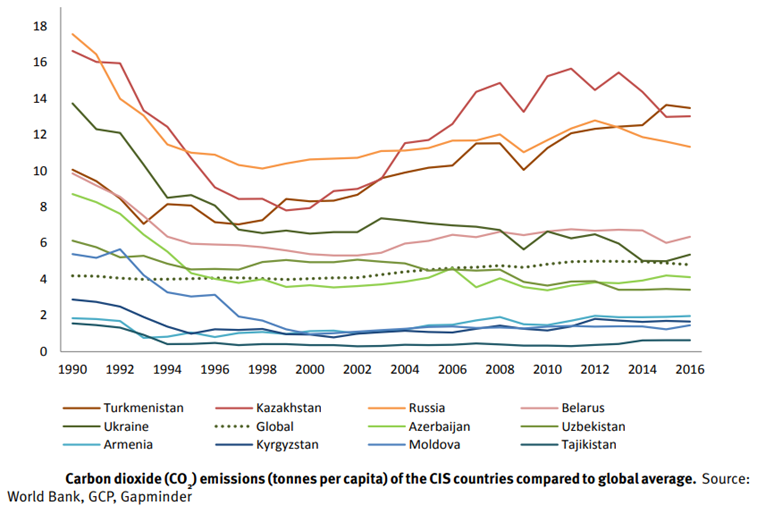
According to estimates made by the Intergovernmental Panel on Climate Change (IPCC) in 2014, under a business-as-usual scenario, greenhouse gas emissions from industry will increase between 50 and 150% by 2050. The authors of this report expect that projected emissions from the burning of fossil fuels in Eastern Europe, Caucasus and Central Asia will increase further. In addition, the regions ecological footprint points in a direction where current patterns of industrial production and consumption will not be compatible with the growing scarcity of natural resources. This has significant implications for the future trajectory of the industrial sector, highlighting the need to transform the current system based on a linear industrial development path towards sustainable energy solutions and clean technologies.
Environmentally Sound Technologies
Based on the proceedings of the First Regional Conference on Sustainable Industrial Development, the findings of this report suggest that policy-makers have to address prevailing barriers, including issues of limited access to finance, review existing procedures and address limited institutional capacities. Creating a level playing field for new technologies eventually helps to build new markets and increases the resilience of local businesses, while creating additional value along the whole value chain. The pursuit of strategies centred on the circular economy boosts employment and provides income-generation opportunities for the local population. Importantly, increased efficiency in energy and resource use and the sustainable management of key resources have proven to generate substantial energy and cost savings on the operational level of enterprises, resulting in a significant reduction of emissions.
Sustainable Energy Solutions
Mainstreaming applicable solutions will require a long-term political commitment to ensuring appropriate policy development, including regulatory frameworks governing products, waste, water, energy, capacity building, economic incentives and the development of appropriate technologies. Technical capacity can be enhanced by providing targeted seminars and trainings. This includes supporting demonstration installations, exhibitions, trade fairs, matchmaking events and education with a focus on vocational and higher education. The United Nations (UN) is well-positioned to provide a platform for interaction and dialogue on the identification, selection, and implementation, as well as the monitoring and evaluation of suitable solutions.
The Development of Sustainable Energy Solutions
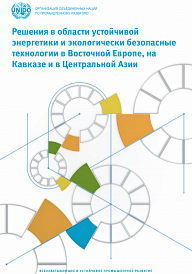
The report provides an outline of current approaches towards sustainable development, highlighting the role of sustainable energy solutions and environmentally sound technologies in industry. Chapter 3 gives an overview of selected case studies from the region, covering different stages, from the identification, selection and implementation to the monitoring and evaluation of suitable solutions. This includes successful examples of interventions in the development of clean technology innovations; the identification of financing mechanisms; the adoption of renewable energy and energy efficiency in small and medium-sized enterprises (SMEs) and large industries; implementing resource efficient and cleaner production; and the sustainable management of chemicals. The chapter also includes a general outline of the concept on Eco-industrial Parks and, finally, monitoring and evaluation. A strong focus is placed on the implementation of applicable solutions on the ground, emphasizing practical approaches to technical cooperation and capacity building, which will help to make industries more resilient and fit for the future on a changing planet.